 Free US shipping $120+ (excl. Hawaii, U.S. islands)
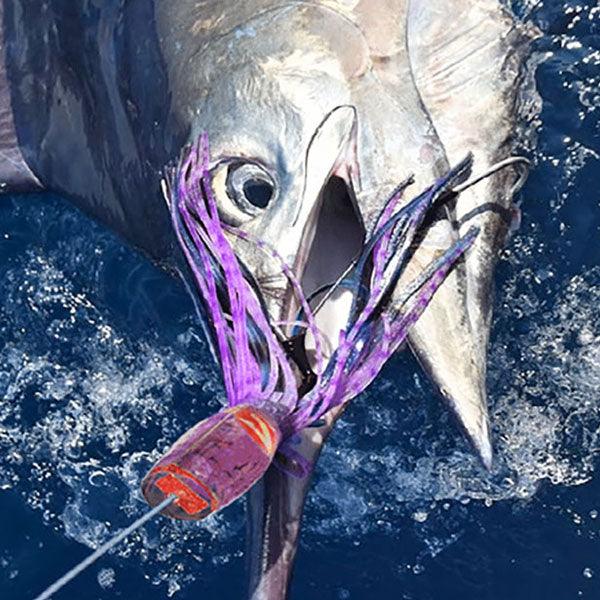
 Ready-rigged, ready to troll
 Save up to $60 on bigger orders
 Shipped direct from the maker


Offshore Trolling Tackle Guide
Mike Liu, Founder of Viketech OffshoreOffshore trolling is not a gear-collecting hobby. A spread either looks like food and holds together under load, or it does not. Three things decide which: how much bulk you put in the water, whether there is a weak link anywhere in the rigging, and whether your speed matches the lures you are pulling. Get those right and colour choice is the easy part.
This guide walks through each one, with the actual numbers off our own tackle.

How fast should I troll?
Speed is the setting most crews get wrong, and it is the cheapest one to fix.
- 7–10 knots is where resin-head lures and dredges swim the way they were designed to. This is the working range for tuna, marlin and mahi.
- Over 12 knots, a surface spread starts skipping and blowing out. At that point you need a planer or added weight to keep the lures in the water instead of on top of it.
- High-speed wahoo trolling is a different game. Run stainless jet-head lures on heavy leader — they are built to hold their line when everything else is tumbling.
If a lure is spinning, skipping or tangling, check speed before you change lures.
Resin head or stainless head?
These are two different tools, not a good-better pair.
| Resin head | Stainless head | |
|---|---|---|
| How it works | Clear high-density resin with holographic or pearl foil set inside. Refracts light. | Marine-grade stainless with jet holes drilled through the face. Pulls a bubble trail. |
| Character | The quiet one — subtle flash, natural profile | The loud one — smoke, noise, easy to track |
| Best in | Clean water, calm days, pressured fish | Chop, dirty water, high speed, low light |
| Sizes | 8.3" to 12.8", 3.3 oz to 9.6 oz | 5.5" to 13.2", 2 oz to 18.5 oz |
| Shop | Resin trolling lures | Stainless trolling lures |

Most crews run both in one spread — stainless out wide where it needs to be seen from a distance, resin closer in where fish get a longer look.
What hook and leader do I need for each species?
Every Viketech Offshore lure ships pre-rigged, so this table is mostly there to tell you what you are getting — and what to match if you rig your own.
| Species | Hook | Leader | Shop |
|---|---|---|---|
| Mahi mahi | 7/0 – 9/0 single | 140 lb | Mahi mahi lures |
| Tuna | 8/0 – 9/0 single | 140 – 180 lb | Tuna lures |
| Wahoo | 6/0 – 9/0, single or double | 400 – 700 lb | Wahoo lures |
| Marlin | 9/0 – 10/0, usually double | 400 – 700 lb | Marlin lures |

Rigging your own or replacing a hookset? We make opposed and aligned double hooksets from 6/0 to 13/0 on stainless cable, plus stainless lance hooks and circle hooks in the same sizes.
Do I need a dredge or a teaser?
A single lure is one small object in a very large ocean. A dredge or a chain solves that by putting a whole bait school behind the boat, so fish pick you up from further out and come in competing.
- Dredge bars — stainless frames in 12", 24" and 36" for hanging silicone flaps or soft baits. Our 36" flap dredge carries 21 flaps. Pick the frame first, then load it.
- Strip dredge teasers — holographic bars in the same 12" / 24" / 36" sizes, for crews who want flash without hanging thirty individual baits.
- Squid daisy chains — our 43" chain runs four 9" UV squids down the mainline with eight 5.2" satellite squids on the arms, two per node, spaced 11" apart. Rigged on 400 lb clear mono with #7 ball bearing snap swivels, and it ships with a mesh storage bag.
- Reflective teaser strips — linear holographic flash for high-frequency reflection on the move. The cheapest way to add visibility to an existing spread.
Fish a chain flat-line off the transom or behind a dredge to raise fish into your hook baits. Nothing on a teaser needs to be hooked — its job is to bring them in close enough to eat something that is.
How do I get the spread deeper?
Some days the fish are there and nothing touches the spread, because they are holding below the thermocline and never come up to look. Surface lures cannot solve that.
A diving planer puts mechanical downward force on the line and drags the spread into the layer they are actually feeding in. Our K-type boards run from #5 (5.9", 1.8 oz) up to #13 (15.3", 12.8 oz), each with its own dive characteristic — bigger board, deeper and harder pull. The full size and k-value chart is on the product page.
What size swivel should I use?
This is where spreads fail, and it is entirely avoidable. Nothing in the connection should be rated below the leader it is tied to.
- Our ball bearing snap swivels run #5 through #9, with a welded split ring on one end and a coastlock snap on the other.
- Pulling a daisy chain built on 400 lb test? Use #7 or bigger at every connection. One undersized swivel and that is exactly where it lets go under load.
- The 360° ball bearing core is not a luxury item — it is what kills line twist so the chain tracks straight behind a dredge or in heavy current.
- For hanging baits off a dredge frame, use heavy-duty corkscrew swivels rather than snaps.
What skirts do I need, and can I re-skirt a lure?
Skirts are the cheapest thing on the boat and the first thing to get chewed up, so keeping spares is normal practice.
- UV soft octopus skirts — 9", 10" and 12", in solid and multi-colour patterns. UV-reactive silicone holds colour down where most of the light spectrum has already dropped out.
- Sea witches and dusters — 4" trolling skirts for dressing ballyhoo, running ahead of a bait, or building your own small-end spread.
- Waxed rigging floss — what we hand-tie our own skirts with. If you are re-skirting, use this rather than whatever is in the drawer; it is what holds under load and does not rot.
How do I stop rigged lures from dying in the box?
Rigged trolling lures are killed by salt and sunlight, not by catching fish. Four steps, every trip:
- Rinse skirts and heads in freshwater as soon as you are in.
- Inspect hook points and steel cable leaders for burrs or fraying — fatigue failure always announces itself before it happens, if you look.
- Air-dry before anything goes away. Damp plus sealed equals corroded hardware.
- Store rolled, not stacked. A 6-pocket roll-up lure bag keeps rigged lures separated, untangled and ventilated, which is the whole problem solved in one item.
Quick reference
| Question | Short answer |
|---|---|
| Trolling speed, resin lures and dredges | 7–10 knots |
| Above what speed do I need a planer? | 12 knots |
| Leader for tuna and mahi | 140–180 lb |
| Leader for marlin and wahoo | 400–700 lb |
| Minimum swivel on a 400 lb chain | #7 |
| Hookset sizes available | 6/0 – 13/0 |
| Dredge bar sizes | 12", 24", 36" |
| Skirt sizes | 9", 10", 12" (plus 4" sea witches) |
Where to start
If you are building a spread from nothing, start with a ready-to-troll kit — the lures are matched to the species, pre-rigged with the right hook and leader, and go in the water the day they land. If you already have a spread and want to make it work harder, add a dredge or teaser before you buy another lure. Raising fish beats replacing lures.
Browse the full range of offshore trolling lures, or shop by what you are chasing: tuna, marlin, wahoo, mahi mahi.
Viketech Offshore — sold direct from the maker.