 Free US shipping $120+ (excl. Hawaii, U.S. islands)
 Ready-rigged, ready to troll
 Save up to $60 on bigger orders
 Shipped direct from the maker


How to Choose Marlin Trolling Lures: A Buyer's Guide
Mike Liu, Founder of Viketech OffshoreShare
Marlin lures look simple. A head, a skirt, a hook, some leader. The differences that matter are not obvious from a photo, which is why people end up buying five to find the one that works.
Here is what actually separates them.
Head shape decides the action
Everything else is preference. Head shape is physics.
| Head | What it does | Best for |
|---|---|---|
| Flat / slant face | Digs in, swims side to side, throws a wide bubble trail | Slower speeds, calmer water, the classic marlin action |
| Cupped / chugger | Grabs air, pops to the surface, then dives | Surface commotion, raising fish from depth |
| Bullet / tapered | Tracks straight, stays in the water at speed | Higher speeds and rough seas where other heads blow out |
| Jet / with holes | Lays a continuous bubble trail | Any speed — the smoke trail is the attractor |
If you fish one boat in one area, you probably need two head types, not six.
Size: match the bait, not the fish
The instinct is to fish big lures for big fish. It is half right.
Marlin eat what is in front of them, and that is usually whatever the local bait is. A 12-inch lure is not big because marlin are big — it is big because it silhouettes like a small tuna or a bonito, which is what a blue marlin is actually hunting.
- 9–11 inch — versatile. Works for striped marlin, sailfish and big tuna as well. Start here if you are running a mixed spread.
- 12–13 inch — dedicated blue and black marlin size. Big enough to discourage most tuna from eating it, which is the point when you are targeting.
- 14 inch and up — specialist. Heavy tackle, tournament spreads, grander water.
Leader rating is not a marketing number
This is where cheap lures give themselves away.
A marlin lure should be rigged on 400lb leader minimum. Not because a marlin pulls 400 pounds — it does not — but because of what happens during a long fight: the leader rubs the bill, the fish rolls and wraps, and a mono leader takes abrasion the whole time. 400lb gives you margin.
Every lure in our marlin collection is rigged on 400lb mono or heavier, crimped at the bench rather than tied on the deck. Hooks are 9/0 and 10/0 stainless, with the larger heads running a double hookset.
Single hook or double?
Both work. The trade-off is real, and it is not about hookup rate as much as people think.
Single hook — cleaner release, less damage to a fish you intend to let go, and less to go wrong. Increasingly the standard in tournaments and on charter boats that release everything.
Double hookset — two points at different angles, which helps when a fish eats sideways or short-strikes. More hold on a big fish that rolls. Some jurisdictions and tournaments restrict them, so check before you fish one.
If you are unsure, start with single. It covers most situations and you will lose fewer fish to a bad release than you gain from the second point.
Where it sits in the spread
A marlin spread is not five copies of the same lure. Each position has a job.
- Short corners — in the prop wash, where the bubbles hide the leader. Smaller, more active heads.
- Long riggers — out and back, in clean water. This is where the bigger lures usually go.
- Shotgun / centre — furthest back, often the biggest lure in the pattern.
- Teasers — no hooks. Their job is to raise the fish so it finds a hook bait. On a lot of boats the teaser does more work than any lure in the spread.
That last point is worth sitting with. If marlin are coming up to look but not eating, the problem is rarely the lure colour — it is that nothing raised them close enough in the first place. Our Strip Dredge Teaser runs 12", 24" and 36" bars — start with one and add more as you learn what your water wants. Pair it with a 43" Squid Daisy Chain further back for extra flash. See the full range of teasers and daisy chains and dredge teasers.
Our marlin lures, by size
Real numbers off our own catalog, resin and stainless side by side:
| Size | Head | Weight | Hook / leader |
|---|---|---|---|
| 11.8" | Resin | 7.2–7.5 oz | 9/0 single or double on 400lb |
| 12.2"–12.8" | Resin | 8.1–9.8 oz | 10/0 on 400lb |
| 12.2"–13.2" | Stainless | 14.8–23.8 oz | 10/0 double on 700lb |
| 15.7" | Resin, magnum | 14.5 oz | Heavy double hookset |
See the full marlin trolling lures range for every size and head type.
How many marlin lures should I run?
Two to four hook baits plus one or two teasers is a normal marlin spread — fewer, bigger positions than a tuna spread. Marlin do not need five choices; they need one convincing lure after the teaser has already raised them. Cover two head shapes (one flat or slant, one bullet or chugger) rather than five colours of the same head.
What we would tell a friend buying their first three
- One 12-inch flat or slant face on 400lb — the workhorse, goes on a long rigger
- One 9–11 inch chugger — surface action, short corner, doubles as a big tuna lure
- One teaser — a squid chain or dredge, no hooks, run close
Three items, three jobs, no overlap. Add colour variations after you know which head shape your water likes — that is a much cheaper thing to change than the lure itself.
For colour specifically, see our guide to trolling lure colours.
What to ignore
Weight alone. A heavy head is not automatically better. Weight determines how deep the lure sits and how it behaves in a chop — it is a tuning parameter, not a quality signal.
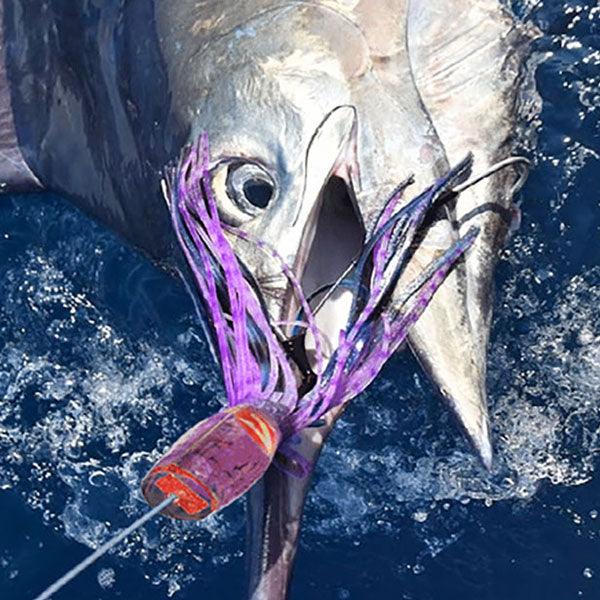
Anything sold on the strength of one photo. Every lure ever made has a photo of it next to a big fish. That tells you the lure was in the water when a fish ate, nothing more.
VIKETECH OFFSHORE — built for the fish that break tackle.