 Free shipping on orders $120+
 Ready-rigged, ready to troll
 $200-$20,$300-$40,$450-$60
 Shipped direct from the maker


Trolling Lure Colours: What to Run, and When
Partager
Ask ten captains which colour catches fish and you will get ten answers, most of them delivered with total confidence. That is because colour is not really about the fish — it is about the water and the light. Once you understand what happens to colour underwater, the arguments mostly resolve themselves.
This guide is the short version of what actually matters when you are picking skirts for an offshore spread.
The one thing to understand first
Water absorbs light unevenly. Red is the first to go — it is essentially gone by 15–20 feet. Orange follows, then yellow. Blue and green travel furthest, which is why deep blue water looks blue.
This has a practical consequence that surprises people: a bright red skirt at 30 feet is not red any more. It reads as dark grey or black. That does not make it a bad lure — a dark silhouette against the surface light is one of the most visible things in the ocean — but it is not doing what you think it is doing.
It is also why our dredge and teaser films are built to throw back blue and green wavelengths rather than the warm end of the spectrum. Down where the fish are looking, that is what is left to reflect.
Colour by water condition
| Water | What to run | Why |
|---|---|---|
| Clear blue (offshore, 100ft+ visibility) | Blue/white, silver, pearl, natural mackerel tones | Fish can see detail from a long way off. Match the bait rather than shout at it. |
| Blue-green (edge water, colour changes) | Green/yellow, chartreuse, blue/silver | Green penetrates well in slightly stained water. This is where chartreuse earns its reputation. |
| Green or stained (inshore edges, after weather) | Chartreuse, hot pink, orange, high-contrast combinations | Visibility is short. Contrast beats realism. |
| Dirty or tannic | Black, purple, dark solid colours | Silhouette is the only signal that survives. Dark reads hardest against the surface. |
Colour by light
Bright sun, flat water. This is when natural flash does its best work. Anything with real reflective material — abalone shell inserts, holographic film, polished metal — is lit up from every angle. Silver, pearl and blue/white are hard to beat.
Overcast, or early and late. Less light to work with, so lean darker and higher contrast. Black/purple and black/red are classic low-light combinations for a reason: they hold their silhouette when everything else washes out.
Dirty water on a bright day. Treat it as low light. The sun is not reaching down there.
Colour by species
These are starting points, not rules. Local knowledge beats any chart.
Tuna — Tuna hunt by sight and are often keyed on a specific bait. Natural tones win more often than not: blue/white, green/yellow, silver. When they are up and feeding aggressively, pink and chartreuse start producing. Tuna trolling lures →
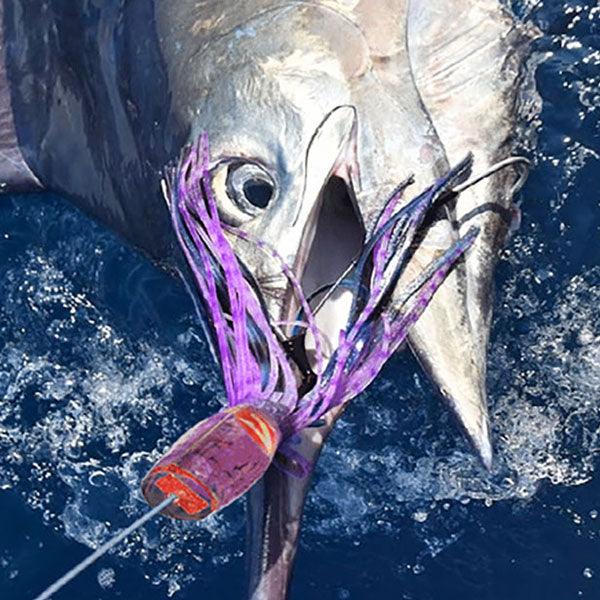
Marlin — Bigger fish, bigger profile, and a strong case for dark colours. Black/purple and blue/black are the two that show up in more spreads than anything else. Marlin often come up to look at the teaser first, so the colour that matters may not be on your hook bait. Marlin trolling lures →
Wahoo — Speed changes the equation. At high-speed trolling pace the fish gets a fraction of a second to decide, so flash and contrast beat subtlety. Black/red, purple/black and anything with a polished metal head. Wahoo trolling lures →
Mahi Mahi — The one species where bright genuinely seems to win. Pink, chartreuse, yellow and orange, in small profiles, worked near weed lines and floating structure. Mahi mahi trolling lures →
Do not run the same colour twice
The most common mistake is not picking the wrong colour — it is picking one colour and running five of it.
A spread is a test. Every position is a question you are asking the ocean. If all five lures are blue/white and nothing eats, you have learned almost nothing. If you have run dark, bright, natural and flash and one of them gets hit twice, you have your answer for the day.
Practical version:
- Run at least one dark and one bright
- Put your confidence colour in the position you fish hardest
- When something gets eaten twice, switch a second lure to match it
- Change colours before you change locations — it is faster and cheaper
This is the reasoning behind selling skirts in six-colour sets rather than singles. One set covers the range, and you re-skirt in the cockpit instead of guessing at the dock.
Quick reference
| Condition | First choice | Backup |
|---|---|---|
| Clear blue, bright sun | Blue/white, silver | Pearl, natural |
| Clear blue, overcast | Black/purple | Blue/black |
| Green water | Chartreuse | Green/yellow |
| Stained or dirty | Black | Hot pink, orange |
| High speed (wahoo) | Black/red | Purple/black |
| Mahi near structure | Pink | Chartreuse, yellow |
The honest caveat
Colour matters less than presentation, speed and being where the fish are. A well-run spread in the wrong colour will out-fish a badly-run spread in the right one, every time.
Use this as a starting point, then let the day tell you what it wants.
VIKETECH OFFSHORE — built for the fish that break tackle.